
Empty tracking fails for a simple reason. The count that matters happens at the door, and the person standing there is busy. A method that asks too much of the driver at that moment will be skipped. A method that asks nothing will give you nothing. This section covers what to set up, a full day of counting, how to chase a gap without accusing anyone, and how to judge any way of tracking empties.
What to set up first
- A starting count of your jars. How many you own, how many are at the plant, how many are with customers. It will be rough. Write it down anyway, with the date. Every later gap is measured against it. In Pyaau, the jars each customer already holds are typed when you add the customer.
- A rule for what counts as an empty. A jar with the right cap and no major damage? Any jar with your marking? Decide once so every driver counts the same way.
- A rule for new customers. A new customer usually holds jars with nothing returned yet. Make sure everyone knows that is expected, so the first weeks do not look like loss.
- A rule for swaps and returns. Does the driver take an empty for each full jar, or does the customer keep a spare? State it per customer type. Offices often keep a spare. Homes often do not.
- A weekly slot to look at the gap. Fifteen minutes, same day each week. Without it, the count is only a record of losses nobody reviews.
A working day of counting
Example, made-up business. Example Aqua’s driver Suresh has 40 jars planned on his route. The numbers are round and illustrative. They are not results from any real business.
At each stop
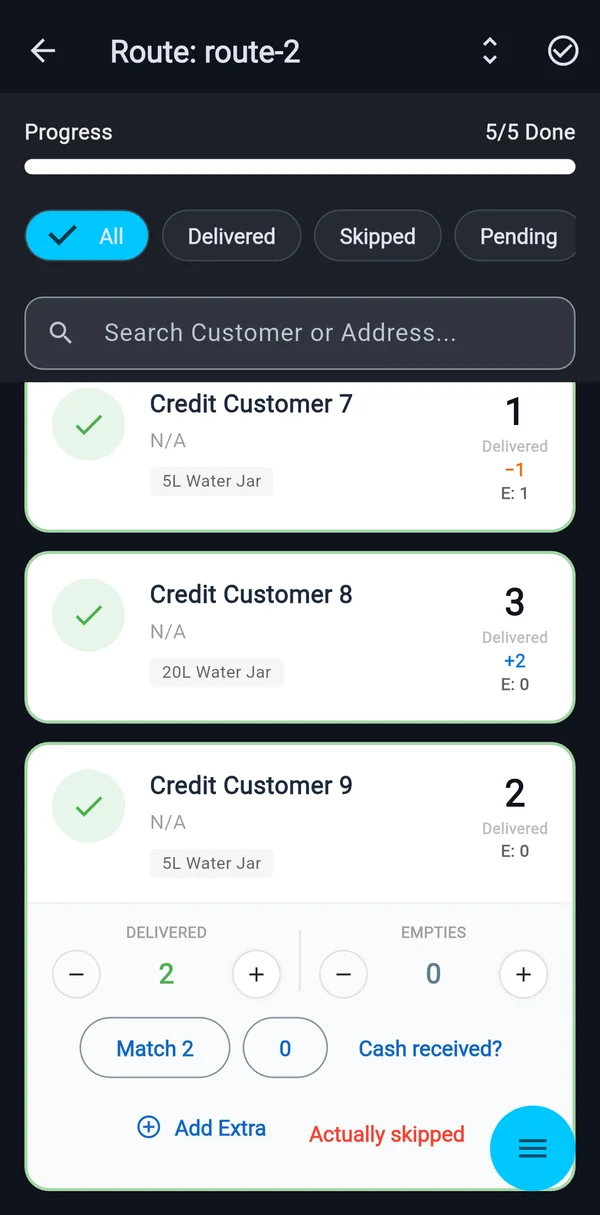
Delivered and empties are two separate numbers. At a home that returns the same number it received, Suresh taps Match and empties become equal to delivered. One tap. At an office that takes 6 and returns 4, he sets empties to 4 by hand. The second counter exists so that “delivered 6, returned 4” is not squeezed into one line.
When a stop is skipped
At one shop the owner is away, but the shutter has 2 empties left outside for pickup. Suresh swipes the stop to skipped, gives the reason, and keeps the 2 empties. The delivery did not happen, the jars did come back, and the record says both.
End of the route
Suresh delivered 36 of the 40 planned jars, because skipped stops covered the other 4, and took back 34 empties. The close-of-day summary shows delivered, skipped, empties and the bottle balance together. The office looks at the gap between jars that went out and jars that came back on this run. Some gap is normal. Customers keep a jar in use, and new customers hold their first ones.
Following the gap
The office does not ask Suresh “where are the jars”. It opens the stops from the day and looks at where empties are below delivered. Three stops show a pattern: a new customer, an office that regularly keeps a spare, and one home that took 3 and returned 1. Two of three have explanations. The third is a phone call to the customer, made on the same day while both sides remember it.
The week after, the same home shows another shortfall. Now there is a pattern with two dates, and the conversation can start with “we delivered 3 on both days and have 2 empties back”.
Mistakes that make the count useless
- Writing returns in the same line as deliveries. You cannot tell later whether 6 minus 4 was a short return or a short delivery.
- Counting empties at the yard instead of at the door. The yard total tells you something is missing. It cannot tell you where.
- Dropping empties from skipped stops. A skipped stop with a returned empty is the easiest one to lose.
- Treating every gap as theft. Most gaps are timing: stock at new customers, jars in use, a spare held on purpose. Accusing a driver over a timing gap ends honest counting.
- Never counting what you own. Without a starting count, you can only discover losses by running out.
- Ignoring jars at the plant. Jars returned to the plant and not yet refilled are still your jars. A rough weekly count there keeps the picture whole.
The longer treatment of why jars go missing and what to do about it is in empty jar tracking: how to stop losing jars. To put a rupee figure on it, use the empties loss calculator.
A checklist for judging any empties method
- Are delivered and returned two separate numbers per stop?
- Is the count taken at the door, by the person at the door?
- Can a skipped stop still record a returned empty?
- Is there a fast way to record “same number back”, since that is most stops?
- Can you see the gap per route and per day, not only in total?
- Can you go from a gap to the stops behind it?
- Can a day be closed so a gap cannot be edited away later?
- Does it need a driver to type words, or only numbers and taps?
- Can the office tell the difference between a driver who forgot to count and a customer who did not return?
- Does it claim to handle deposits? If it does, ask exactly what it records, and check how deposits are handled in your own business separately.
What the data looks like in Pyaau
These screens exist in the app today.
- Stop expanded. Delivered and Empties counters, a Match button that sets empties to the delivered number, and a way to mark the stop as actually skipped.
- Route run cards. A delivered stop shows its empties. A skipped stop that still took back an empty shows that count. Short stops show -1 and extra stops show +2.
- Jars held. On each customer’s page, a count per product marked as coming back as empties. It starts from the jars typed when the customer was added, shown as the first row “Opening balance”, and changes on every delivery. In the demo, 3 delivered plus 2 delivered minus 4 returned left 1 jar held.
- Warning on the stop. If the empties entered are more than the customer holds, the stop shows a warning, and so do the one-stop screen and the review list. It warns and still saves.
- Run summary. Delivered, skipped, extras, empties, bottle balance, short jars and above planned, then Lock Run.
- Short and extra deliveries report. Switch between customer and route over any date range, and tap a row to see the stops behind it.
The page on jar return and empties has the short version, and what to record on every jar delivery explains the fields in a fuller routine.