
Why a second route changes the job
With one route the owner is also the control system. You know the driver, the customers and roughly how many jars should come back. With two routes you start relying on reports. With four, you cannot hold the picture in your head, and the business moves from trusting people to checking structure.
That is a different skill. The aim is not to watch drivers more. It is to give every route the same shape, so that when numbers differ you can tell whether the cause is the route, the customer or the way the driver records.
Example: a morning and evening across four routes
Example only. The numbers are made up and round. They are not results from any business.
A distributor has four routes. Route 1 is dense, with offices and shops. Route 2 is housing societies. Route 3 is a long run to a nearby town. Route 4 is a mix of old customers.
Night before. Each route’s stops are prepared. The distributor checks only two things. Does any route have far more stops than the others? Are temporary orders due to end this week?
Morning. Four drivers leave. The distributor does not phone any of them.
Evening, comparing the four.
| Route | Planned stops | Delivered | Skipped | Jars out | Empties back |
|---|---|---|---|---|---|
| 1 | 40 | 38 | 2 | 100 | 96 |
| 2 | 30 | 29 | 1 | 120 | 110 |
| 3 | 15 | 12 | 3 | 45 | 44 |
| 4 | 35 | 34 | 1 | 70 | 55 |
Route 4 stands out. Jars out are 70, empties back 55. Nothing else is that far apart. The distributor does not decide the driver is careless. First question is whether Route 4’s customers are older credit customers who hold extra jars at home, which is a customer pattern. Second is whether this gap has been there for a week. Only if it has been persistent and unexplained does it become a driver conversation.
The order to read many routes
- Check completeness first. Did every route’s run get closed for the day? An open run has missing data and its numbers will look better or worse than they are.
- Compare skip rate across routes. A route with far more skips has a customer problem or a driver problem, and the reasons tell you which.
- Compare empties against jars out, per route. Use a few days of data. Single days mislead.
- Look at short and extra by route over a fortnight. One route with repeated extras may need its standing orders raised. One with repeated short may be over-promised.
- Check who owes most. If the biggest dues sit mostly on one route’s customers, the driver’s collection habits or the customers’ terms may differ. The dues report lists customers, so you match them to routes yourself.
The guide on running multiple delivery routes covers how to size and split routes in the first place.
Setup advice for a multi-route business
- Assign every customer to exactly one route. A customer on two routes will appear twice, or on neither.
- Use one naming style for routes and stops. “Route 1 morning” and “Rajendra Nagar” cannot be compared. Pick one scheme.
- Move a customer’s schedules with the customer. When you change a customer’s route, check that their standing orders follow. Pyaau shows a warning when they stay behind.
- Give each driver a separate login. Without it, per-route comparison tells you nothing about people.
- Standardise what counts as a skip. If one driver skips for “customer not home” and another for “will deliver tomorrow”, the skip counts are not comparable. Agree three or four reasons.
- Review pricing per customer before you scale. The wider the business, the more private deals exist. Standing orders and pricing per customer shows how to hold them.
Mistakes multi-route owners make
- Comparing routes without adjusting for what they are. A long route to another town will always have fewer stops per hour.
- Running every route on the same morning start. Customers on a route may prefer different times, and the schedule should reflect it.
- Rewarding the best-looking numbers. A driver who skips awkward customers has clean numbers and unhappy customers.
- Changing several things at once. If you change prices, routes and drivers in the same month, you cannot tell what caused the difference.
- Ignoring the month before festivals. Demand shifts unevenly across routes. See summer and festival demand planning.
How Pyaau supports a multi-route business
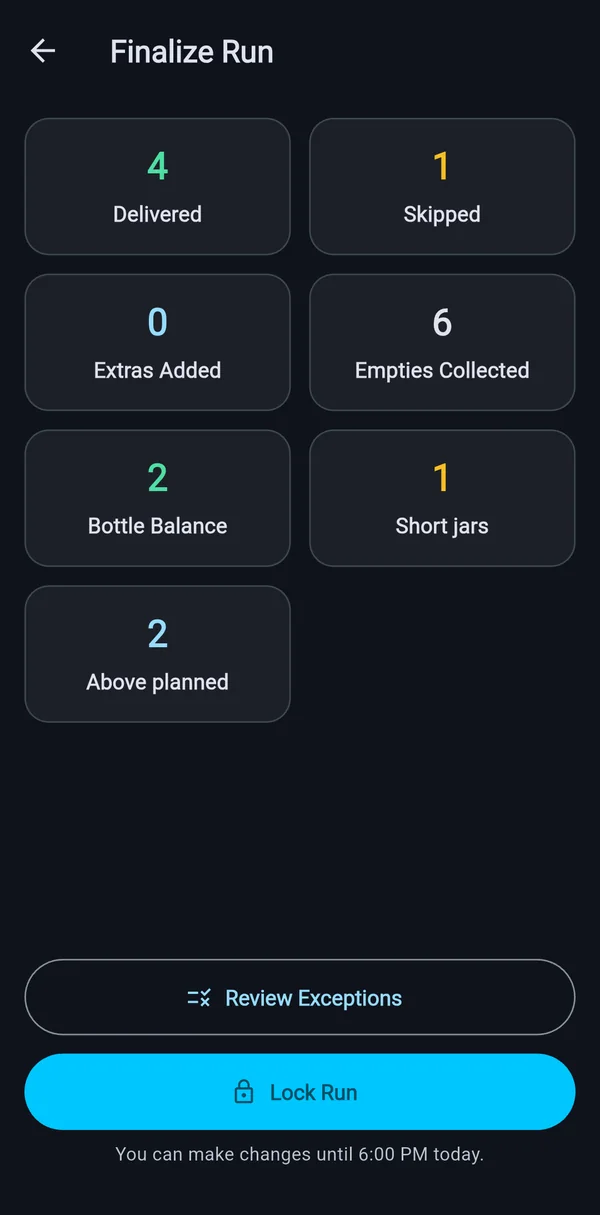
Every night each driver’s stops are prepared from customers and standing orders. Each route has its own run. At the end of the day each run has a summary showing delivered, skipped, extras, empties, bottle balance, short jars and jars above plan.
The short and extra report can be switched between customer and route over any dates, and a tap on a row shows the stops behind it. The dues report gives ageing buckets and the customers owing most. The office locks each run after reviewing exceptions.
There are two roles. The office (admin) sees and edits everything. A driver records deliveries, extras and payments, and only the office can cancel or edit a payment. Each business is one office and its drivers.
If your empties numbers are the worry, the page on jar return and empties tracking goes further. For the single-owner view of the same evening, see for water plant owners.