
A bill gets accepted when the customer can see where each number came from. In a jar business, billing arguments usually come down to count. How many jars, on which days, and what was already paid. This section follows one customer’s bill from the first delivery of the month to the last payment, then covers what to set up, what goes wrong and how to judge any billing method.
What to set up before you bill anyone
- A price per customer. Many businesses have a catalogue price and a few customers on a negotiated rate. Write down the rate you actually agreed with each one. If a rate lives only in the owner’s head, the invoice will be wrong whenever someone else prepares it.
- Opening dues. For every credit customer, what they owed on the day you start recording. Without it the first invoice looks fine and the ledger never agrees with your old notebook. In Pyaau you type it when you add the customer. It shows as the first ledger row, “Opening balance”, and no invoice is made for it.
- A closing routine for each delivery day. A bill can only be as good as the days behind it. If days are not checked and closed, invoices inherit every unchecked mistake.
- A billing rhythm. Weekly, fortnightly or month-end. Pick one per customer type and tell customers. Shops that pay weekly and offices that pay monthly can sit on different rhythms. In Pyaau customers pay monthly on an invoice by default, and any customer can be set to pay daily, in which case no invoice is made.
- A rule for who may change a payment. Decide now that drivers record money and the office corrects it. An open edit right on a recorded payment is how balances drift.
One customer’s bill, step by step
Example, made-up numbers. Example Aqua delivers to a small office on a negotiated rate of ₹40 a jar. The figures are round and illustrative. They are not results from a real business.
During the month
Each day the driver records what was delivered at the door, plus empties. On the 12th the customer pays ₹1,000 in cash at the door and the driver records it. Over the month the office delivers 60 jars, which comes to ₹2,400 at ₹40.
Closing the day before it is billed
Billing is only safe on days that have been reconciled. Each evening the office compares delivered, skipped and extras with the plan, fixes anything odd while the driver remembers, and closes the day. This is dull work and it is what makes the invoice defensible.
Raising the invoice
At month-end the invoice is raised from the reconciled days. It lists the deliveries it covers. The customer sees dates and counts, so a question like “did you come on the 9th?” has an answer on the page. The ₹1,000 paid at the door is already deducted, so the balance due on this invoice reads ₹1,400.
When money comes in
The customer later pays ₹1,000 by UPI. The office records it with the method and date. The payment goes against the oldest unpaid invoice first. The invoice moves from Unpaid to Part paid, and the balance due drops to ₹400.
The next month
A second invoice is raised for ₹2,000. The customer now has an older invoice with ₹400 due and a newer one. Say they pay ₹1,000 the following week. It clears the old ₹400 first, and ₹600 goes against the newer invoice. Nobody has to say which bill the money was for. The oldest-first rule settles it the same way every time.
Mistakes that cause disputes
- Billing from memory. If the invoice is built from a register or from the owner’s recollection, the customer’s recollection is equally valid. A bill backed by dated deliveries is a different conversation.
- Billing days that were never checked. One wrong swipe in the month becomes a wrong line on the bill.
- Recording a payment late or not at all. Cash taken at the door and not noted is the most common leak. The customer remembers paying. Your book does not.
- Changing rates without a date. If a rate changes in the middle of the month, the bill needs to show which deliveries used which rate.
- Letting money sit unapplied. A payment that is not matched to an invoice leaves old invoices looking unpaid and customers feeling accused.
- Chasing the biggest balance only. Age matters as much as size. The guide to reading a dues ageing report explains how.
The full routine for avoiding arguments at month-end is in month-end billing for water suppliers without disputes.
A checklist for judging any billing method
- Does each invoice list the deliveries behind it, by date?
- Is the price per customer stored, or retyped at billing time?
- Can billing happen only from days that have been checked?
- Are payments recorded with a method and a date?
- Are payments applied in a fixed, visible order?
- Is a part payment shown clearly on the invoice?
- Can you see, for each customer, invoices unpaid and deliveries not yet invoiced as two separate numbers?
- Can you list who owes what, grouped by how old the debt is?
- Who may cancel or edit a payment, and is that limited?
- Does it produce what your customers and your accountant actually need, including tax documents if you issue them? Check this before you commit, not after.
A spreadsheet can satisfy several of these if you build and maintain it carefully. It struggles with the first and third, and with controlling who edits what.
What the data looks like in Pyaau
These screens exist today.
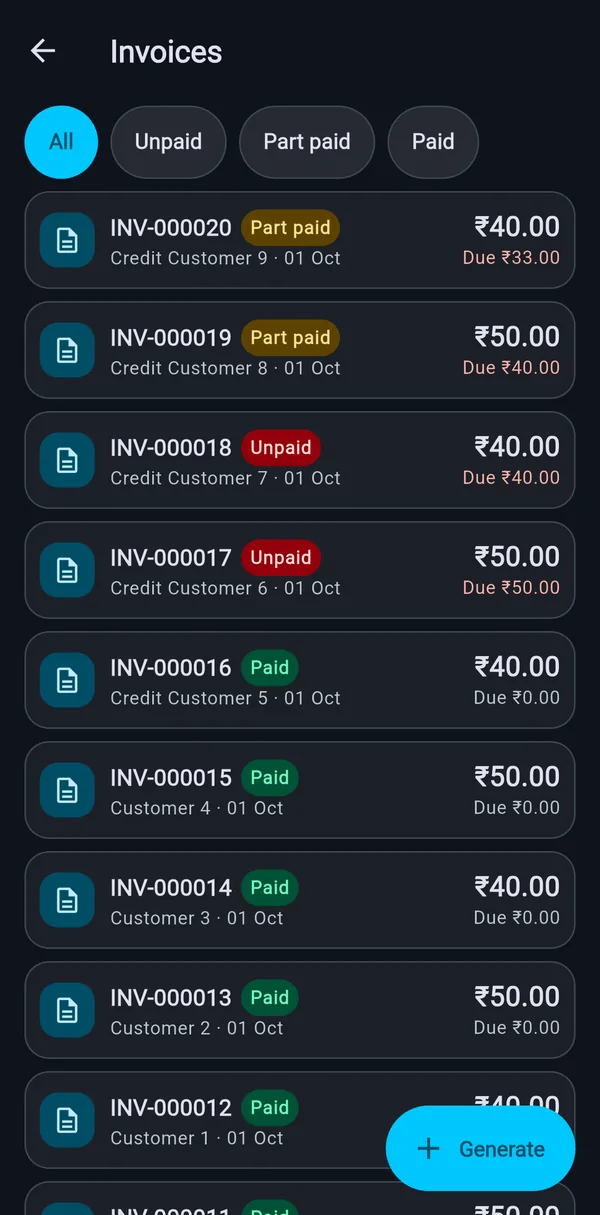
- Invoice list. Every invoice marked Paid, Part paid or Unpaid, with what is still due.
- Invoice detail. Balance due, what was paid later, the delivery lines, and a Record payment action.
- Summary invoice. One row per product and rate, then a day-by-day grid of jars delivered for each month. The per-delivery layout is still there from the invoice menu.
- Vendor code. Added on a customer, copied onto each new invoice and printed on its PDF.- Change prices. On an issued invoice, type a new rate for a product. Every delivery at the old rate changes, the invoice total, its status and the customer’s balance follow, and the invoice keeps a record of each change: who, when, why, and the totals before and after.
- Share. An invoice can be shared as a PDF from the phone through WhatsApp or any other app.
- Record payment. Amount, method (cash, UPI, bank or other), date and a note.
- Customer ledger. Invoices and payments in one list with the running effect on the balance.
- Dues report. Total outstanding, ageing buckets at 0 to 30, 31 to 60 and over 60 days, and the customers owing most.
- Standing order price. Each order carries its own price. If none is set, the catalogue price is used, so the invoice follows what you agreed.
The ledger side, including unpaid versus not yet invoiced, is on the credit customer ledger page. Rate set-up is covered in standing orders and pricing per customer.
Invoices can be shared as a PDF through WhatsApp or any other app. Coming next: WhatsApp billing and a web admin panel.