
A ledger is only useful if someone looks at it on a schedule. The book can be perfect and still leak money if nobody asks who is two months behind. This section walks through a week in the life of one credit customer, then the set-up that makes the numbers right, the habits that go wrong, and how to judge any ledger, paper or software.
What to set up first
- Opening balances, customer by customer. Sit with your old notebook and write down what each customer owes today, or has paid ahead. Ask big customers to confirm the figure. A confirmed opening balance saves you from a dispute you would otherwise have in month three. In Pyaau you type it when you add the customer.
- A payment rhythm and a credit rule per customer type. Homes, shops, offices and hotels behave differently. Decide who pays monthly on an invoice and who pays daily on delivery. For the monthly ones, decide how long each type is allowed before you chase, and write it in one line.
- One person who owns collections. If everyone chases, nobody does. Name one person in the office who reviews dues each week.
- A rule for door cash. When the driver takes money at the door it is recorded right then, on that stop, against that customer. Never “at the end of the day”.
- A rule for corrections. Drivers record. The office alone cancels or edits a recorded payment, and says why in the note.
One credit customer, one week
Example, made-up business. Example Hotel buys jars from Example Aqua on credit. The numbers are round and illustrative. They are not results from a real business.
Monday, the starting picture
The customer’s balance reads Owes you ₹5,500. Two parts sit behind that number. ₹4,000 is on an invoice raised last month and still unpaid. ₹1,500 is for jars delivered this month that are not yet on any invoice. Keeping these apart matters. The first amount is late. The second is simply not due to be billed yet.
Tuesday, a payment at the door
The driver delivers 10 jars. The hotel’s manager hands over ₹500 in cash for the older bill. Once the payment is recorded against the customer, the balance moves to ₹5,000, not at the end of the month.
Wednesday, a question
The manager calls and says he paid more than that. The office opens the customer’s ledger. Invoices and payments sit in one list, each row showing what it did to the balance. The office finds the ₹500 payment on Tuesday and no other payment this month, and reads the dates out. The manager checks his own cash book and finds the other ₹1,000 was paid to someone at the plant, not to a driver. The office looks it up on the plant side, and if it is found, a payment is entered with a note saying where it came from. Without one list in date order, this call would take an hour and end with a guess.
Friday, the weekly review
The office opens the dues report. Total outstanding is split into 0 to 30, 31 to 60 and over 60 days, with the customers owing the most listed first. The hotel’s invoice is now past 30 days. The office makes a note to phone the manager on Monday, and to send the statement with the call. The account stays friendly, because the call happens in week five and not month five.
Month-end, the invoice
The ₹1,500 of deliveries goes onto a new invoice raised from reconciled days. The customer now has two invoices, and any payment will go to the older one first.
Habits that leak money
- Chasing only the loudest. Quiet customers with old balances are the ones that go bad. Review by age, not by who calls.
- Mixing “late” with “not yet billed”. If both sit in one number, you cannot tell a real overdue from a normal gap between delivery and invoice.
- Door cash written on a slip. A slip gets lost. A payment recorded at the stop is part of the record from that moment.
- Never calling about small balances. Small balances stretch into large ones. A customer who is a few days late is easy to ask. A customer who is ninety days late is a negotiation.
- Letting delivery continue unchecked. Decide a limit past which you pause deliveries until a payment arrives, and apply it evenly.
- Writing off silently. If you decide a balance is lost, record that decision somewhere dated. Do not let it sit as live dues.
The wider picture is in how to stop credit leakage in a water jar business, and you can put a figure on it with the credit leakage calculator.
A checklist for judging any ledger
- Is there one balance per customer, labelled clearly as owed to you or owed by you?
- Are invoices that are unpaid shown separately from deliveries not yet invoiced?
- Are invoices and payments in one list in date order?
- Can a payment be recorded from the delivery stop?
- Is the order in which payments settle invoices fixed and visible?
- Is there a report grouped by age of debt?
- Does it show who owes the most?
- Can you limit who edits or cancels a payment?
- Can you give a customer a statement they can check?
- Does it quietly assume you take online payments? If you do not, check that it still works for cash and UPI recorded by hand.
If you keep a spreadsheet, it can pass many of these. The weak points are usually age grouping and who is allowed to change a cell. See how to read a dues ageing report for what to do with the age view once you have it.
What the data looks like in Pyaau
These screens exist today.
- Customers list. Every customer with their balance marked Due or Credit.
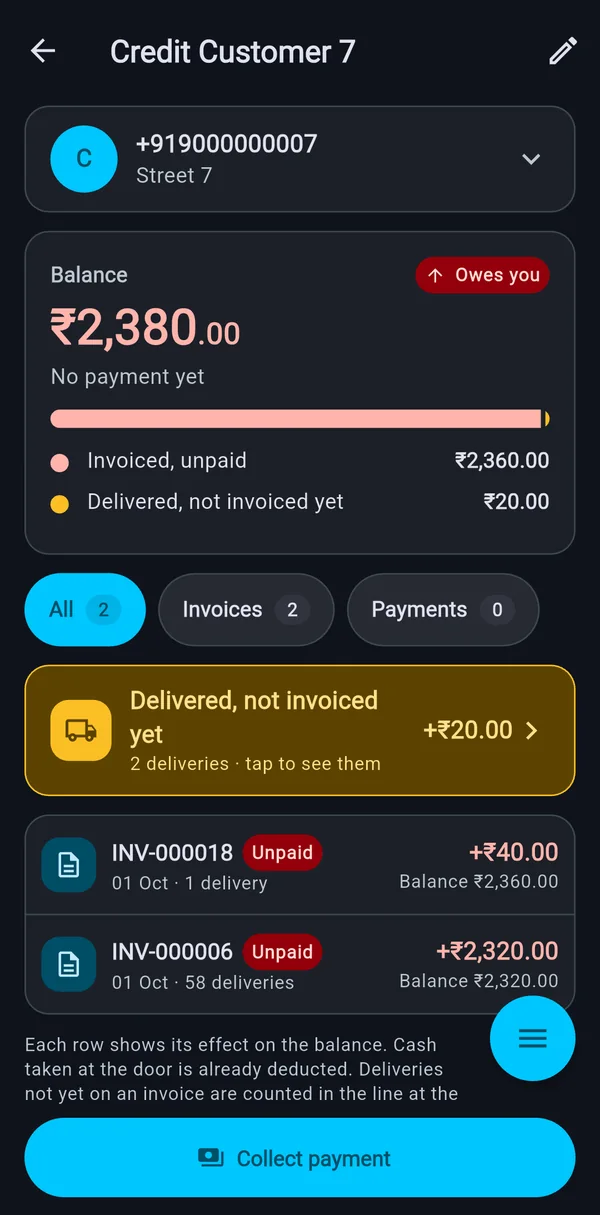
- Customer ledger. Balance marked Owes you or Credit, invoiced unpaid, delivered not invoiced yet, then invoices and payments in one list, and a Collect payment button.
- Timeline. On each customer page, deliveries and payments sit in one list, newest first, with the balance after each row, for the last 30 days.
- Opening balance. When you add a customer you enter what they already owe or paid ahead. It shows as the first row, “Opening balance”, and no invoice is made for it.
- Pays daily or pays monthly. Customers pay monthly on an invoice by default. Any customer can be set to pay daily. A daily payer gets no invoice, and their ledger runs on its own. Changing the setting changes nothing in the past.
- Record payment. Amount, method (cash, UPI, bank or other), date and note, on the office’s side.
- Invoices. Each marked Paid, Part paid or Unpaid.
- Dues report. Total outstanding, 0 to 30, 31 to 60 and over 60 days, and customers owing most.
- Home dashboard. Collected today and this month, billed this month and customer outstanding.
In the demo, one customer’s balance went from ₹2,380 to ₹1,880 after a ₹500 payment was recorded, and the payment appeared in the list straight away. That is demo data.
Drivers can record cash or UPI at a stop, and the office sees who is late in the dues report. Coming next: WhatsApp billing and a web admin panel.
The billing side is on the billing page.