
The owner’s problem is attention, not data
Owners of jar businesses rarely lack information. They lack a short, fixed way to read it. A paper register has everything, but you have to be standing next to it, and the driver who wrote it has to explain it. By the time you have rung three drivers, the day is over and the next one has started.
A good evening routine takes about fifteen minutes and asks the same questions in the same order every day. Fixed order matters because it lets you notice change. You stop reading numbers and start reading differences from yesterday.
Example: one owner, five drivers, one evening
Example only. The numbers are made up and round. They are not results from any business.
An owner runs five routes. At 6 pm she sits down with tea.
Step 1, was the work done? Planned stops were 120. Delivered 108, skipped 12. She expected a few skips. Twelve is a bit high.
Step 2, where are the skips? Nine of the twelve are on one route. The reason on most of them is the same, shop closed. It was a local holiday in that area. She makes a note, not a call.
Step 3, jars. 260 jars went out. 240 empties came back. The gap is 20, and the running balance for that route has grown for three days. This is the thing worth a conversation tomorrow morning.
Step 4, what was different from plan? Two customers got extras. One customer got one jar fewer than planned. She looks at who and why.
Step 5, money. ₹18,000 was collected today against ₹52,000 billed this month so far. She does not act on this today. She looks at the oldest dues once a week.
The whole read took a quarter of an hour because the order was fixed.
What an owner needs to see, in order
- Delivered against planned. If this is off, nothing else is trustworthy yet.
- Skipped, with reasons. A skip with a reason is information. A skip without one is a hole.
- Empties and bottle balance, per route. Read the trend over days, not a single day. One short day can be a delayed return.
- Short and extra. Short means fewer jars than planned were delivered. Extra means more. Both change the bill, and extra is where price slips happen. See short and extra deliveries explained.
- Collected today, and what customers owe. Collection is a weekly discipline. Daily it is only a pulse.
- Lock the day. Once exceptions are reviewed, close the run with Lock Run.
What the owner should not do
Do not fix numbers on the driver’s behalf at night. If the office quietly edits a stop, the driver learns that the record does not matter. Ask first, then correct.
Do not read everything every day. Skip the ageing buckets on weekdays. Read them on a fixed weekday.
Do not use one bad day to judge a driver. Use a range of dates. Compare routes over two or three weeks before drawing conclusions. The guide on driver accountability without micromanaging sets out how to do that without turning every evening into an inquiry.
Setup advice so the evening read can be trusted
- Give each driver their own login and only that. Shared logins make “who recorded this” unanswerable.
- Agree what a valid skip reason is. Customer closed, customer did not need jars, address problem. Write the list for drivers once.
- Decide who may edit a payment. In Pyaau only the office can cancel or edit a recorded payment. Tell drivers this early so it is not a surprise later.
- Review for a fortnight against your old notebook. Keep the notebook running for two weeks. Differences show you where drivers need coaching or data needs cleaning.
- Fix the customer list first. Duplicate customers and wrong routes produce exactly the exceptions you then spend your evening reading.
Common mistakes in owner routines
- Reading the home number only and never opening the detail behind it.
- Looking at dues only when cash is tight.
- Changing standing orders informally, by phone, so the route no longer matches the customer’s real need.
- Locking days late, which leaves a week of editable history.
- Mixing two questions, “is the driver honest” and “is the data right”. Settle the data first. See how to stop credit leakage in a water jar business for the money side.
How Pyaau supports the evening read
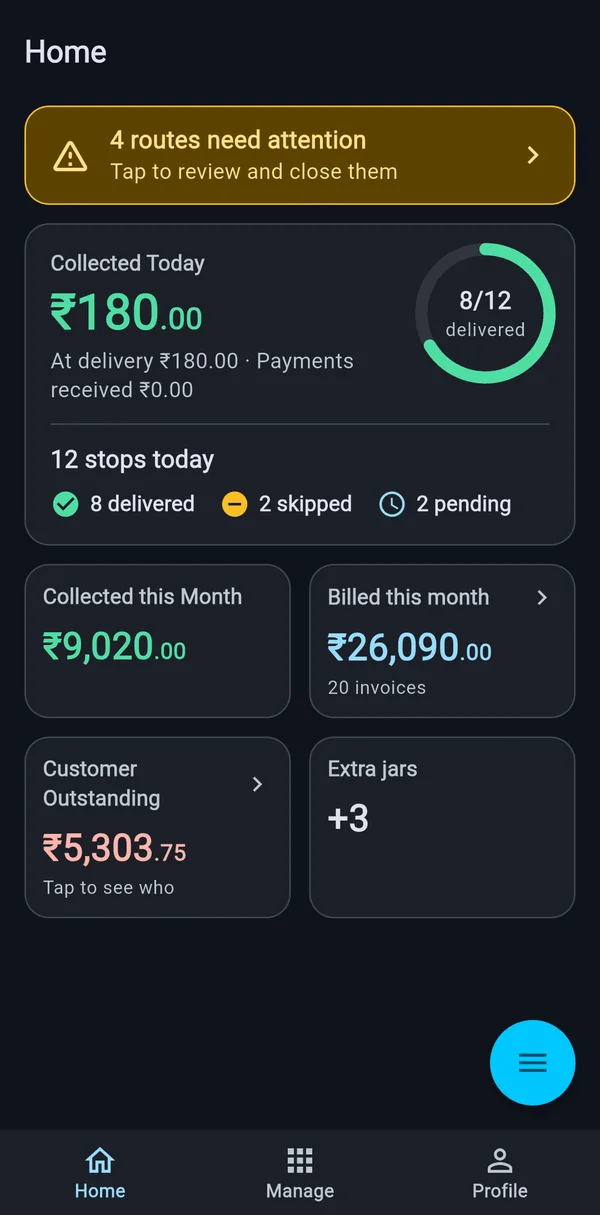
The home dashboard shows what was collected today and this month, a delivered ring, billed this month, customer outstanding and extra jars. Each number leads to its detail.
The close-of-day summary for a run shows delivered, skipped, extras, empties, bottle balance, short jars and jars above plan. The office reviews exceptions and then uses Lock Run.
The short and extra report can be switched between customer and route over any dates, and tapping a row shows the stops behind it. The dues report gives total outstanding, 0 to 30, 31 to 60 and 60 plus day buckets and the customers who owe most. Each customer has a ledger with Owes you or Credit, invoices and payments in one list, and Collect payment.
There are two roles. Office (admin) and driver. A driver can record deliveries, extras and payments, and only the office can cancel or edit a payment.
Coming next: WhatsApp billing and a web admin panel.
For the billing side of the same evening, see month-end billing for water suppliers without disputes. If you run several routes, the page for distributors with multiple routes goes further on comparing them.