
Split the plant into two ledgers before you buy any software
An RO plant that delivers its own jars runs two businesses under one roof. The first turns raw water into filled jars. The second moves those jars to customers, collects the empties and collects the money. They fail in different ways. A bad batch is a production problem. A customer who owes four months is a delivery-side problem, even though the jar was perfect.
Most owners keep both in one head and one notebook. That is why the delivery side gets attention only when something breaks. The practical first step is to decide what the delivery side must answer every evening, whatever tool you use.
- How many jars went out, and how many empties came back?
- Which standing customers were not served, and why?
- Who collected jars from the plant, and what did they pay?
- What did customers owe this morning, and what do they owe now?
If you can answer those four from a record and not from memory, the delivery side is under control.
Example: a day at a plant with three routes and a counter
Example only. The numbers are made up and round to show the shape of a day. They are not results from any business.
A plant fills jars from 5 am. Three drivers leave at 7:30. The counter sells to walk-in customers all day.
Evening before. The office checks tomorrow’s list. Say 90 stops are planned across the three routes. Two of them are temporary extras for a family function that ends on Friday.
7:30 am. Drivers load. The owner has one number in mind, the jars needed for the planned stops, and fills the truck against it. In the example that is 140 jars including a few spares.
10:00 am. A customer phones for one more jar today. The driver or the office records it as an extra. The price is different from the customer’s regular rate because it is a one-off, so the owner needs to know.
11:00 am. A shop owner walks in and takes 10 jars from the counter, paying ₹300 in cash. That is a plant pickup, and it needs its own record so the cash is not lost between the counter and the day’s totals.
2:00 pm. Drivers return. Two stops were skipped because the shops were closed. One driver brought back three empties from a customer who was out but left them at the gate.
6:00 pm. The owner reads the day. Planned against delivered, empties against jars out, cash against what the ledger says should have come in.
Everything a plant owner really worries about in that day sits in the gaps between those lines.
What to look at, in what order
At the end of the day an owner has limited attention. Use this order.
- Jars out against empties back. A widening gap over several days is the earliest sign of lost stock.
- Skipped stops and their reasons. Two shops closed is weather. Eight skipped on one route is a conversation with the driver.
- Extras and price flags. Extras are where discounts quietly appear.
- Plant pickups against cash. The counter is the easiest place for money to go unrecorded.
- Dues. Only last, because dues move slowly. Look at the oldest bucket weekly, not hourly.
For a deeper method on what every delivery record should contain, see what to record on every jar delivery.
Setup advice for a plant
Start with the catalogue and one honest price list. Every customer falls back to the catalogue price unless they have their own. If your catalogue is wrong, every invoice is wrong in the same direction.
Enter standing customers as standing orders, not as one-off orders. A shop that takes 6 jars every alternate day should be a schedule with its own price. Typing it fresh every morning is how routes drift away from reality. The guide on standing orders and pricing per customer covers the structure.
Keep counter customers separate from route customers. Someone who collects from the plant is a pickup customer. Putting them on a route creates stops nobody will ever deliver.
Set the first month up as a trial with a few customers. Pick one route. Compare the app’s totals with your notebook for two weeks before trusting it for billing.
Mistakes plant owners make
- Treating production count as delivery count. Filled jars are not delivered jars. Spares, breakage and counter sales all sit between them.
- Giving every customer the same price to keep things simple. It is simple until the third customer negotiates and nobody remembers the deal.
- Letting drivers decide price on extras. One-off pricing needs the owner’s eye, at least as a flag.
- Not writing down plant pickups. Cash received at the counter is the most commonly lost small amount.
- Chasing dues only at month-end. By then the oldest balance is already two months old. How to read a dues ageing report explains the buckets.
Margin questions, such as whether a far route is worth running, belong in a separate exercise. The guide on jar business profit basics is a good start.
How Pyaau helps the delivery side of a plant
Pyaau is built for the second half of the plant’s work. The office builds customers, routes and standing orders once. Every night the next day’s route is prepared for each driver.
Drivers swipe stops delivered or skipped. They set jars delivered and empties taken back, and a skip needs a reason. The close-of-day summary shows delivered, skipped, extras, empties, bottle balance, short jars and jars above plan. The office locks the run after reviewing it.
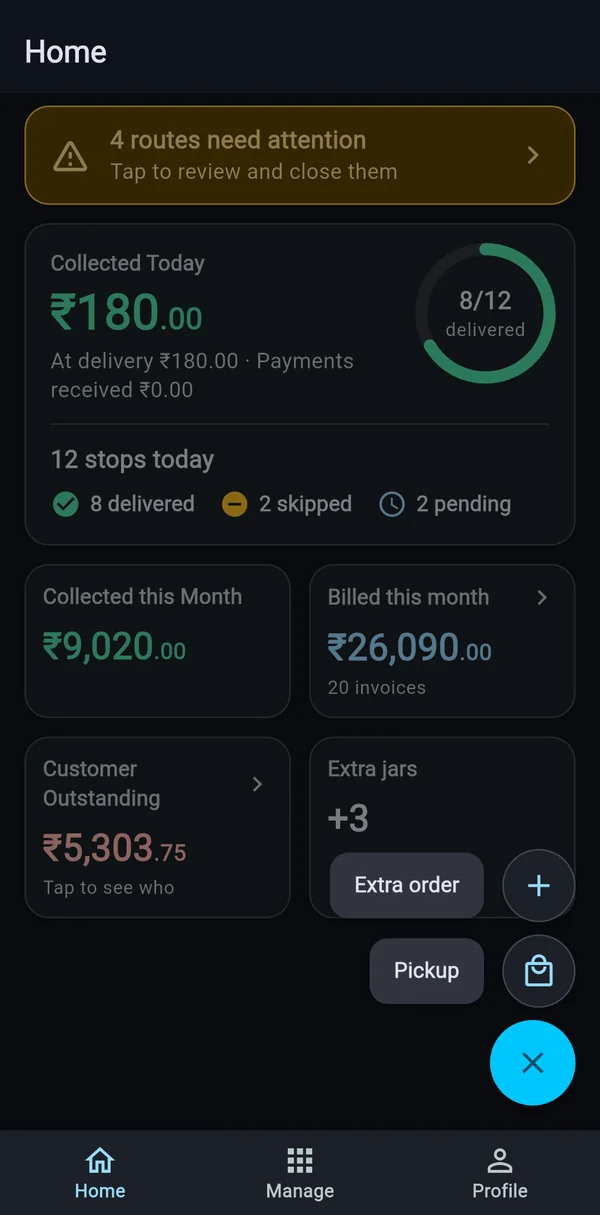
The round add button on the home screen opens two plant-specific entries. One is an extra order, with a flag for the owner when the price changed. The other is a plant pickup, recorded with the amount received. Standing orders can be daily, alternate days or weekly, each with its own price, or temporary with an end date.
Customers pay monthly on an invoice by default, and any customer can be set to pay daily instead, in which case no invoice is made. Either way a delivery adds to the balance, a recorded payment brings it down, and the ledger shows Owes you or Credit. Invoices are raised from days you have reconciled, and payments are applied to the oldest invoice first.
Coming next: WhatsApp billing and a web admin panel.
If you want to see how an owner reads the evening numbers, the page for water plant owners shows the screens.